When people mention “Yama,” or “Phaya Yama,” as he is commonly known in Thailand, many immediately picture a stern-looking deity who judges the good and evil deeds of the deceased after they leave this world. However, did you know that Yama plays different roles in different religions and cultures? Whether in Hinduism, Buddhism, or traditional Thai beliefs, although they share similar origins, each has its own distinctive interpretations.
This article will introduce the role of Yama from the perspectives of these three traditions, while providing a clear comparison of their similarities and differences.
Yama in Hinduism: The God of Death and Judge of Souls
In the Vedas, one of the principal sacred scriptures of Hinduism, Yama is regarded as the first being to die and the one who opened the path to the afterlife. For this reason, Yama is revered as the ruler of Yamaloka (the realm of the dead) and the judge of the souls of the deceased.
In Hinduism, Yama has a distinctive appearance. He is commonly depicted riding a buffalo and carrying a mace and a noose, symbolizing his authority to seize souls. He uses the “Noose of Yama” to capture the souls of those whose lives have come to an end, and then judges their deeds before sending them to heaven or hell according to their karma.
Yama in Buddhism: A Judge of the Dharma, Not a Deity
In Buddhism, Yama is not regarded as a deity. Instead, he serves as a representation of the law of karma, illustrating how the law of karma operates. In Buddhist stories and teachings about the underworld, Yama appears to emphasize that every human action has consequences after death.
In the Tipitaka (Pali Canon), King Yama is described as questioning the souls of the deceased about their conduct during life. For example, he asks, “Why did you not do good while you were still alive?” or “Did you not see others die before you?” These questions are intended to awaken a sense of remorse in the soul and to remind readers that life is impermanent and that they should hasten to do good while they still can.
Although Yama in Buddhism has a role similar to that of Yama in Hinduism, he does not have the authority to determine a person’s karmic outcome. That judgment depends entirely on the karma each individual has created, rather than on Yama acting as the one who punishes them.
Yama in Thai Beliefs: A Blend of Religion and Local Tradition
In Thai culture, Phaya Yama represents the judge of souls after death. This image has been shaped by both Hinduism and Buddhism, while also incorporating elements of traditional Thai folk beliefs.
Many Thai people believe that after death, a person’s soul must appear before Phaya Yama, who determines whether it will go to heaven or hell. Traditional beliefs also speak of Yama’s messengers who escort souls, Nirayabals who punish wrongdoers, and multiple levels of hell, each corresponding to different kinds of sins, such as hells for those who kill animals or those who steal.
In Thai funeral ceremonies, references to Phaya Yama can also be found in various rituals, such as making merit and dedicating it to the deceased, guiding the departed spirit toward a better realm, and praying for Phaya Yama’s compassion. All of these practices reflect people’s faith in and hope for Yama’s justice.
Similarities and Differences of Yama in the Three Traditions
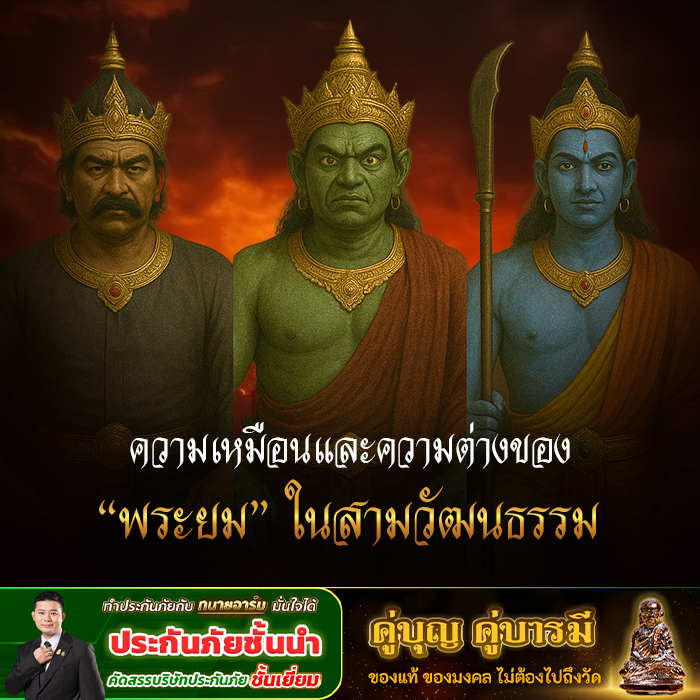
Similarities
- In Hinduism, Buddhism, and Thai beliefs, Yama, or Phaya Yama, is associated with death and the consequences of karma.
- He represents justice and responsibility for one’s actions.
- He is commonly portrayed riding an animal, wearing sacred ornaments, and carrying a noose or other weapons used to capture souls.
Differences
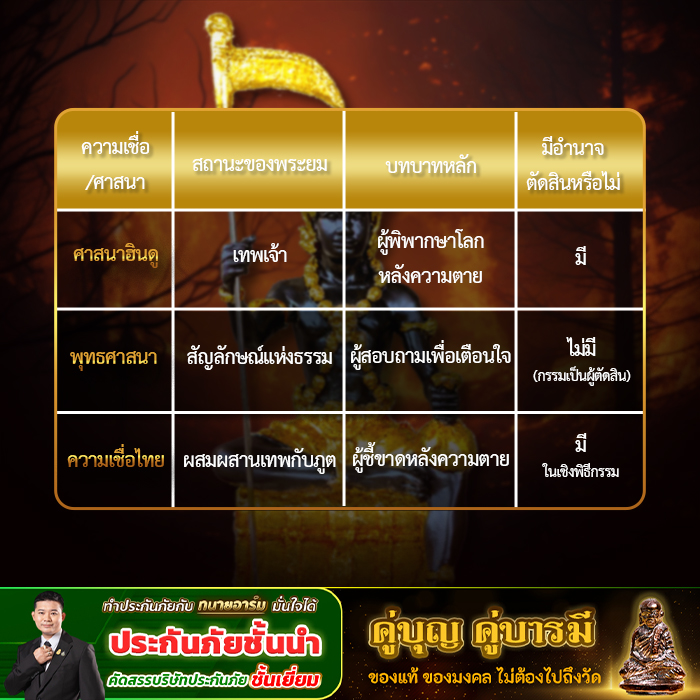
Yama: A Reflection of Human Karma and Morality
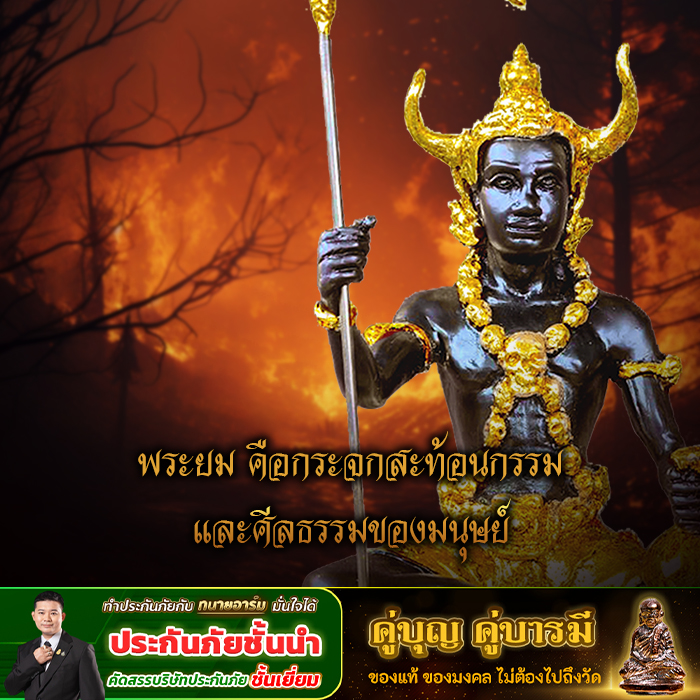
Although Yama, or Phaya Yama, is portrayed differently across various cultures, they all share one important message: to remind people of the consequences of karma and the uncertainty of life. Whether represented as a powerful deity, a symbol of the law of karma, or a cultural figure, Yama remains a symbol of justice in the afterlife.
Therefore, if we are to fear Yama, we should fear him in the sense of living without mindfulness. In the end, regardless of one’s religion, it is the karma we create through our own actions that ultimately judges us.