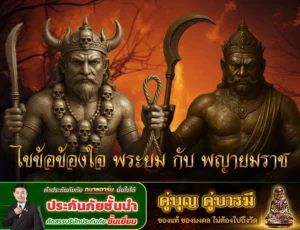
When people hear the names “Yama” or “King Yama,” many immediately think of the deity who judges the good and evil deeds of souls after death. Some also simply call him “Yommalaban” or “Yommarat.” This raises an important question: Are Yama and King Yama the same figure?, or do they have different meanings?
This article from ARM’S ARMOR will take you through the origins and meanings of Yama and King Yama, drawing from religious beliefs, cultural traditions, and literary sources, while providing a clear comparison of their similarities and differences.
Who Is Yama?

Yama originated from Hindu beliefs and is one of the ancient deities mentioned in the Vedas, the sacred scriptures of Hinduism. He is regarded as the God of Death and the ruler of Yamaloka, the realm of the dead, where he serves as the judge of the good and evil deeds of humanity.
In Hinduism, Yama is commonly depicted riding a buffalo while carrying a noose and a mace. His duty is to lead the souls of the deceased to be judged according to their karma. After examining the good and bad deeds committed during life, he sends each soul to heaven or hell in accordance with the consequences of its actions.
Who Is King Yama?

In contrast, King Yama, or Phra Yamaraja, appears in Buddhist scriptures such as the Tipitaka (Pali Canon) and the Dhammapada Commentary. He is described as the King of Yamaloka, or the ruler of hell, whose duty is to question the souls of the deceased about the deeds they committed during their lifetime.
Unlike Yama in Hinduism, King Yama is not portrayed as a deity possessing divine supernatural powers. Instead, he serves as a symbol of the law of karma, reflecting the principle that those who commit wrongdoing must face the consequences of their own actions. Nirayabals or Yama’s messengers are responsible for bringing souls before him for questioning before they receive the appropriate punishment.
The Relationship Between Yama and King Yama

Although Yama and King Yama originate from different religious traditions, they share the same fundamental concept of judging the good and evil deeds of souls after death. In other words, both serve as “judges” in the afterlife and perform similar roles:
- Receiving the souls of the deceased.
- Examining or questioning their actions during life.
- Directing them to their next destination in the cycle of rebirth, such as heaven, hell, or rebirth into a new life.
As a result, Thai beliefs have gradually blended the Hindu concept of Yama with the Buddhist concept of King Yama, creating a harmonious combination. This is why many Thai people use the two names interchangeably.

Yama in Thai Culture
In Thai culture, the concepts of Yama and King Yama have gradually merged into the figure of Phaya Yama, who is widely recognized as the judge of souls in the afterlife. He frequently appears in folk literature, Buddhist chants, funeral traditions, and Dhamma teachings, for example:
- The story “King Yama Questions the Deceased,” reminds us that everyone should diligently do good deeds because death may come unexpectedly.
- Funeral rituals in which people ask Phaya Yama for forgiveness, praying that the deceased may be reborn in a better realm.
- Beliefs about Yama’s messengers coming to escort the souls of the dead, as well as the common expression, “You’ll be dragged away by Yommalaban,” all reflect people’s fear of karma and death.
Yama in the Context of Buddhist Teachings
In Buddhism, Yama or King Yama is not the absolute authority who punishes beings. Instead, he serves as a representative of the Dharma in the role of “the questioner,” encouraging souls to become mindful and accept the consequences of their own karma. A well-known example is when King Yama asks the deceased:
“When you saw others die, why did you still live carelessly?”
This question reminds us that, in truth, the one who judges us is not Yama, but our own karma.
Yama and King Yama: Different, Yet Closely Connected
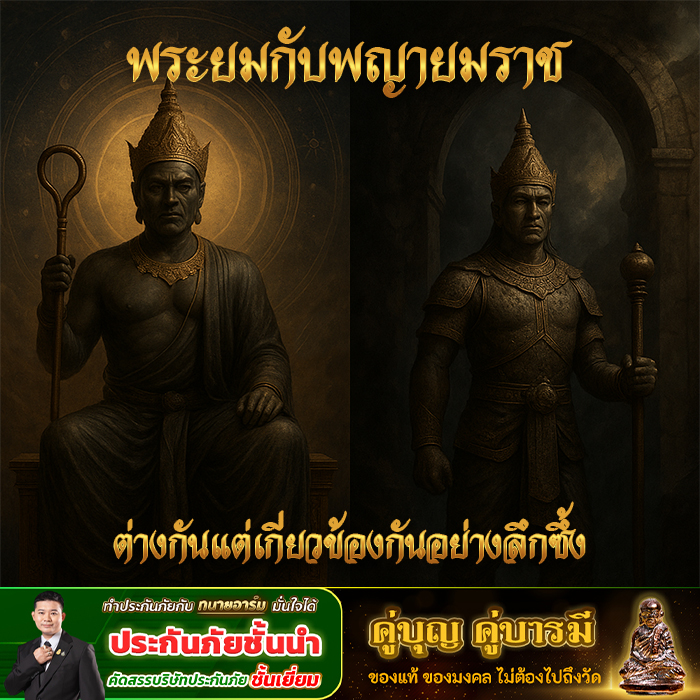
Although Yama and King Yama originated from different religious traditions and have different roles in detail, both are generally regarded as judges of the good and evil deeds of souls after death. More importantly, they both remind people to live without negligence and to be mindful of their actions.
Understanding these differences allows us to better appreciate the cultural roots of Thai beliefs, while gaining a deeper understanding of the Buddhist teachings reflected in the stories of Yama.
If you are interested in sacred amulets and spiritual objects, we warmly invite you to visit our website. ARM’S ARMOR is always happy to serve you.