

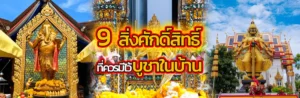
Worshipping deities and sacred objects is a common practice in Thai society. Whether it is asking for wealth, seeking blessings, or hoping for success, it serves as a source of spiritual support and confidence for many believers. It is also another way to encourage oneself and boost morale. Today, the ARM’S ARMOR team has selected nine sacred items that are suitable for worshipping at home and would like to share them with everyone.

Lord Ganesha
Lord Ganesha is one of the most widely worshipped deities in Hinduism. He is well known for removing obstacles and is regarded as the god of beginnings and wisdom. According to legend, Ganesha was created by Goddess Parvati from the dust of her body and was given life. Later, Lord Shiva accidentally cut off his head, and an elephant’s head was placed in its place. Worshippers believe that Lord Ganesha can help bring success in business, prosperity in trade, and wealth, especially for occupations related to the arts. He is also believed to bring success in other areas, such as education, finance, and love. Popular forms of worship include the Blessing Form, the Blissful Form (Reclining Ganesha), the Musical Form (Gita Ganesha), the Five-Faced Form (Panchamukha Ganesha), and the Reading or Writing Form (Vidya Ganesha).

Goddess Lakshmi
Goddess Lakshmi is widely worshipped in Hinduism as the goddess of wealth, good fortune, and prosperity. She is also regarded as a symbol of beauty and feminine charm. According to legend, Lakshmi emerged from the foam of the ocean when the devas and asuras churned the Ocean of Milk in search of the nectar of immortality.

Brahma
Brahma is one of the supreme deities in Hinduism and is regarded as the creator of the universe and all things. His four faces symbolize the ability to see in all directions and the understanding of four kinds of wisdom. His four arms represent wisdom and creation, while the swan, which serves as his mount, symbolizes knowledge and wisdom.

Vessavana (Kubera)
Vessavana, also known as Kubera, is the deity of wealth and possessions in Buddhist and Hindu beliefs. He is one of the Four Heavenly Kings and is responsible for protecting the heavens and the human world. He rules over yakshas and spirits and also protects Buddhism. Vessavana is depicted in two forms, namely a yaksha form and a human form. People often worship him to pray for wealth, good fortune, and other blessings.

Guanyin Bodhisattva
Guanyin, also known as Avalokitesvara Bodhisattva, is widely worshipped, especially in China. She is regarded as the Bodhisattva of compassion and mercy. Guanyin is often depicted as a beautiful woman dressed in white with a halo around her head and holding a lotus flower. The lotus symbolizes purity and enlightenment, while the vase of nectar symbolizes healing and the bringing of peace. People believe that worshipping Guanyin can help with career advancement, smooth finances, love, good fortune, and protection from illness

Caishen
Caishen is the God of Wealth worshipped by Chinese people. It is believed that Caishen descends to the human world only once a year, during the Chinese New Year. Therefore, Thai people of Chinese descent traditionally set up an altar to worship Caishen first on Chinese New Year’s Day. People believe that worshipping Caishen can help their businesses prosper, bring success, and attract wealth.

Fu, Lu, and Shou
Fu, Lu, and Shou are the three Chinese deities of good fortune that have been worshipped by Chinese people for a long time. They symbolize three kinds of blessings. Fu represents good luck, fortune, and wealth; Lu represents rank, blessings, and authority; and Shou represents longevity. People believe that worshipping Fu, Lu, and Shou brings prosperity, happiness, and good health.

Pixiu
Pixiu is a mythical creature in Chinese folklore that combines the features of a lion and a dragon. It is regarded as a symbol of wealth, good fortune, and protection from negative influences. It resembles a lion or a Chinese guardian lion, with wings, a long tail, horns, and sharp teeth. Pixiu is depicted with its mouth open, and people believe that it attracts wealth and good fortune. Since it has no anus, it is believed that wealth entering it will not flow out. People believe that worshipping Pixiu can bring continuous wealth without financial loss, help businesses prosper, and attract good fortune.

Naga King
The Naga King is a mythical being in Buddhist and Hindu beliefs. It is a semi-divine serpent of the snake lineage, appearing as a giant snake with great power. The Naga King plays an important role in the folklore of Southeast Asia and is divided into four lineages: the Virupaksa lineage, or the Golden lineage; the Erapatha lineage, or the Green lineage; the Chhapphyaputta lineage, or the Rainbow lineage; and the Kanhagotama lineage, or the Black lineage. Worshippers believe that honoring the Naga King helps build spiritual merit, brings good fortune and abundance, keeps the family peaceful and harmonious, and protects them from all kinds of dangers.
What do you think of the article? These are some of the great topics we have carefully selected for everyone. If you enjoy our articles, feel free to follow the ARM’S ARMOR website or like the ARM’S ARMOR Facebook page. We will continue to bring you more great content.