

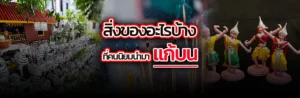
Fulfilling a vow is part of Thai culture and is commonly performed when a request made to a sacred being has been successfully granted. The items commonly offered for fulfilling a vow vary according to beliefs and locations. For example, some people offer zebra statues when fulfilling a vow. As more zebra statues are placed at a shrine, people may come to believe that zebras must be offered there. In fact, the word “zebra (Ma Lai)” may sometimes have originated from a variation of the word “garland (Ma Lai).” However, regardless of what is offered, having sincere faith in the offering is sufficient. Let us take a look at the items that people commonly offer when fulfilling a vow.

1. Incense and Candles
Incense and candles are among the most basic offerings commonly used in worship and prayer. Whether making a vow, seeking blessings, or returning to fulfill a promise after a wish has been granted, people often light incense and candles to inform the sacred beings and express their gratitude.

2. Flower Garlands and Fresh Flowers
Another popular offering, second only to the traditional practice of lighting incense, is the presentation of flower garlands and fresh flowers. People generally choose flowers with auspicious meanings that are believed to bring blessings and good fortune, such as jasmine, marigolds, lotuses, and orchids. Among these, marigolds are often the most popular choice for fulfilling a vow.

3. Fruits
Fruits are another popular offering used for fulfilling a vow. The type and quantity of fruit offered often depend on the promise made when the wish was first requested. For example, some people may vow to offer one hundred bunches of bananas, one hundred kilograms of oranges, or one hundred coconuts once their wish is granted. Common fruits used for fulfilling a vow include bananas, oranges, and coconuts.

4. Thai Desserts
Alongside fruits, Thai desserts are also commonly offered as part of vow-fulfillment ceremonies. Traditional Thai sweets have long been an important part of Thai culture and are frequently included in religious offerings and ceremonial arrangements. Popular choices include Thong Yip, Thong Yod, Khanom Chan, and Khanom Tian.

5. Beverages
Beverages are another essential offering commonly presented during worship and vow-fulfillment ceremonies. Water is typically included among the offerings, while certain drinks may be selected according to the preferences associated with specific deities or sacred spirits. For example, red soft drinks are often offered to Kumarn Thong, while alcoholic beverages may be presented to deities worshipped in Chinese traditions.

6. Betel Nut and Betel Leaf
Another traditional offering commonly used for fulfilling a vow is betel nut and betel leaf. People in ancient times believed that people of earlier generations enjoyed chewing betel, so betel nut and betel leaf are often included among vow offerings. For example, they may be offered to Phoo Pu and Mae Ya.

7. Pig’s Head
In Chinese belief and traditional culture, the pig symbolizes abundance, prosperity, and wealth. For this reason, a pig’s head is often regarded as an important offering for worshipping deities, honoring ancestors, making wishes, fulfilling vows, and participating in ceremonial rituals. It is believed to represent a smooth and prosperous life throughout the year. In Thai beliefs, a pig’s head is also associated with ease and success, symbolizing that things will proceed smoothly and without major obstacles.

8. Boiled Chicken
In addition to a pig’s head, boiled chicken is another popular offering used in worship and vow-fulfillment ceremonies. Whether honoring ancestors or worshipping deities, many Thai people, especially those of Chinese descent, commonly include a whole boiled chicken among their offerings. The chicken symbolizes diligence and hard work because it wakes early each morning. As a result, it is believed to promote career advancement, professional success, and prosperous business ventures.

9. Boiled Eggs
In Chinese belief and traditional culture, eggs symbolize birth, abundance, good fortune, and happiness. As a result, they are commonly used in various religious ceremonies and traditional customs. In Thailand, eggs are also widely presented as offerings because they are believed to bring blessings and auspicious fortune, making them a popular choice for fulfilling a vow.

10. Traditional Dance Performances for Fulfilling a Vow
Traditional dance performances reflect Thailand’s cultural heritage and long-standing beliefs that have been passed down through generations. In the past, theatrical entertainment was highly popular among Thai people, and promising a traditional dance performance as an offering became a common form of vow fulfillment. In some cases, people may even sponsor an outdoor movie screening as a way of fulfilling their vow.

11. Votive Dolls
One type of offering commonly seen in vow-fulfillment practices is the votive doll. These dolls are often presented to celestial beings, guardian spirits, or local protective deities residing in spirit houses and small shrines located around homes. In the past, people frequently promised theatrical performances as part of their vows, with the scale of the performance depending on what had been pledged. Over time, these symbolic stages evolved to reflect changing customs and lifestyles. Traditionally, simple theatrical figures were molded from white clay and displayed in miniature open-air stages. These figures usually consisted of three characters: a male lead, a female lead, and a male attendant.

12. Unique and Location-Specific Offerings
Some sacred beings or deities are associated with particular types of offerings. This may be because those offerings are traditionally believed to be favored by the deity, or because devotees have repeatedly offered the same items over time until they became established local customs. As a result, each sacred site may develop its own distinctive vow-fulfillment traditions. For example, boiled eggs are commonly offered at Wat Luang Pho Sothon, fighting rooster statues are frequently presented at Chao Pho Suea Shrine, and zebra statues are often offered at the Grandparents’ Shrine in Muang Thong Thani.
If you enjoyed this article, feel free to follow ARM’S ARMOR through its official website, and don’t forget to like, follow, and stay connected with the ARM’S ARMOR page. We have many more informative and interesting articles waiting to be shared with you.