
The Chinese Hungry Ghost Festival is an important tradition among Thai people of Chinese descent. On this day, descendants pay tribute to their deceased ancestors by preparing traditional Chinese offerings, including joss paper, paper clothing, and other paper offerings, and to worship their ancestors at the cemetery.The festival falls on the 15th day of the 7th month of the Chinese lunar calendar, which is usually about two months later than the Thai lunar calendar. Accordingly, it generally corresponds to the 14th day of the waxing moon in the 9th lunar month of the Thai calendar. The festival is regarded as an important occasion for descendants to express gratitude and filial piety toward their ancestors through ancestral worship. According to Chinese belief, the gates of the underworld are opened on this day, allowing spirits to return and receive the merit dedicated to them by their families. Therefore, descendants prepare offerings so that their ancestors may receive merit and food, while also sharing these offerings with wandering spirits.
History of the Chinese Hungry Ghost Festival
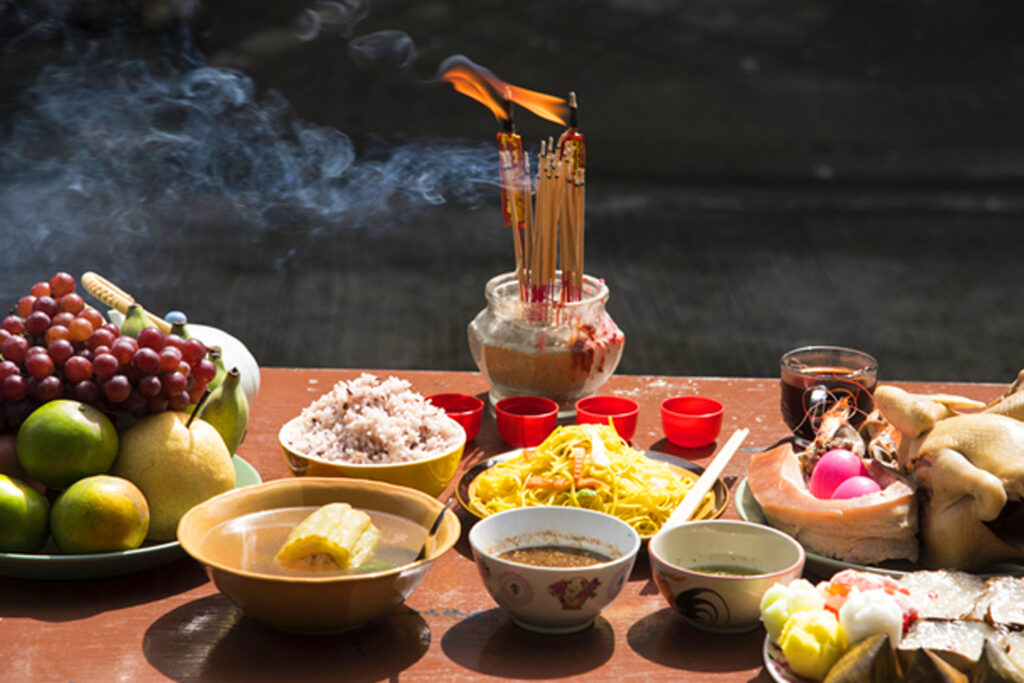
The Chinese Hungry Ghost Festival is a traditional occasion when descendants express their gratitude and filial piety to their deceased ancestors. It is also a time for family members to gather and take part in the festival together. The festival is sometimes referred to by Chinese people as Gui Jie (Ghost Festival) or Wangren Jie (Festival of the Departed). It falls on the fifteenth day of the seventh month of the Chinese lunar calendar and is officially known as the Zhongyuan Festival. The ancestral worship ceremony is held on the fifteenth day of the seventh lunar month, which is traditionally regarded as the Ghost Month. According to Chinese belief, the gates of the underworld are opened during this period, allowing spirits to receive the merit dedicated to them. Throughout the year, Chinese families observe eight major traditional worship festivals, collectively known as the Eight Seasonal Worship Festivals (Po Joi). It is also believed that on the Hungry Ghost Festival, Chenghuang Emperor (Cheang Hi Tai Tee) examines the records of the deceased, sending virtuous spirits to heaven and evil spirits to hell. Out of compassion, people make merit and dedicate it to the spirits. Therefore, the gates of the underworld are opened so that wandering spirits may also receive these merits. Chinese tradition also believes that on the full moon of the seventh lunar month, the spirits of deceased family members are allowed to return to the human world to visit their loved ones. For this reason, descendants perform ancestral worship on this day.
For generations, Chinese families have continued to observe this tradition by performing ancestral worship. They prepare offering tables with both savory and sweet foods, together with joss paper and paper money, as offerings to their ancestors. In addition, separate sets of food are placed in front of the house as offerings for wandering spirits. According to traditional belief, if no offerings are prepared for these spirits, they may take the ancestors’ offerings for the food offered during the ceremony.
Chinese Hungry Ghost Festival Worship Ceremony
On the morning of the festival, people first pay respects to the household guardian spirits and burn joss paper and paper money. At around 11:00 a.m., they set up an altar to worship their ancestors and make offerings to Ho Hia Tee. Some families prefer to perform the ceremony in the afternoon. If the ancestral worship and the offering to Ho Hia Tee are conducted at the same time, separate offering tables should be prepared, although the joss paper and paper money may be burned together. Besides being a tradition through which descendants express gratitude and filial piety toward their deceased ancestors, the Chinese Hungry Ghost Festival also serves as an opportunity to encourage family members to return home and reunite. Since many Chinese families have members working far from home, both the Chinese New Year and the Hungry Ghost Festival have long been regarded as important occasions for family reunions.
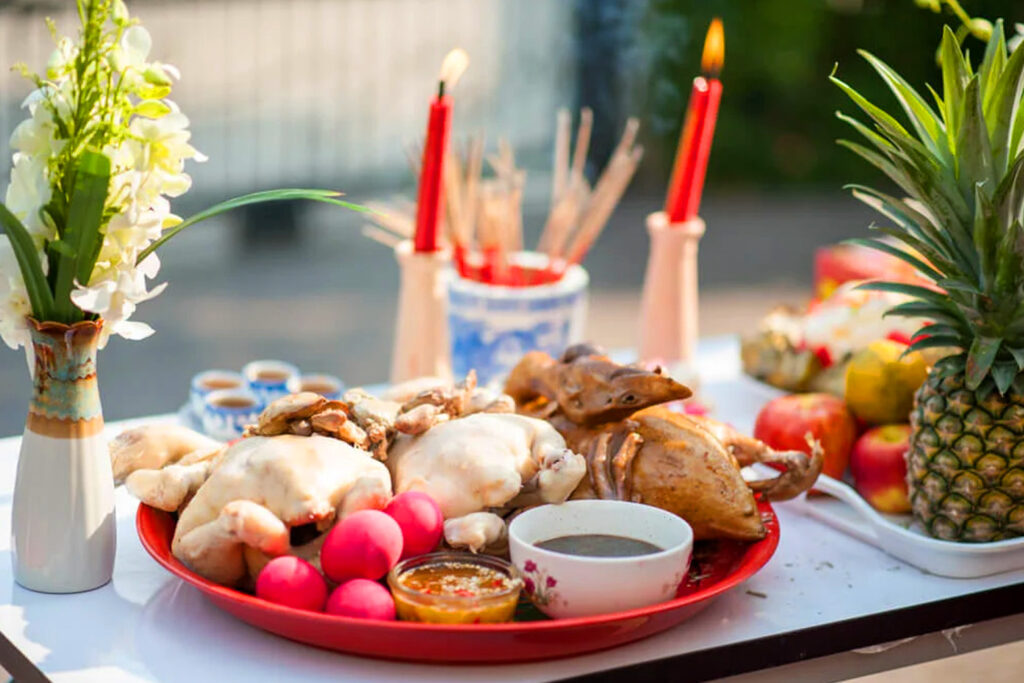
The offerings prepared for the Chinese Hungry Ghost Festival are divided into three categories.
1. Offerings for the Household Guardian Spirits
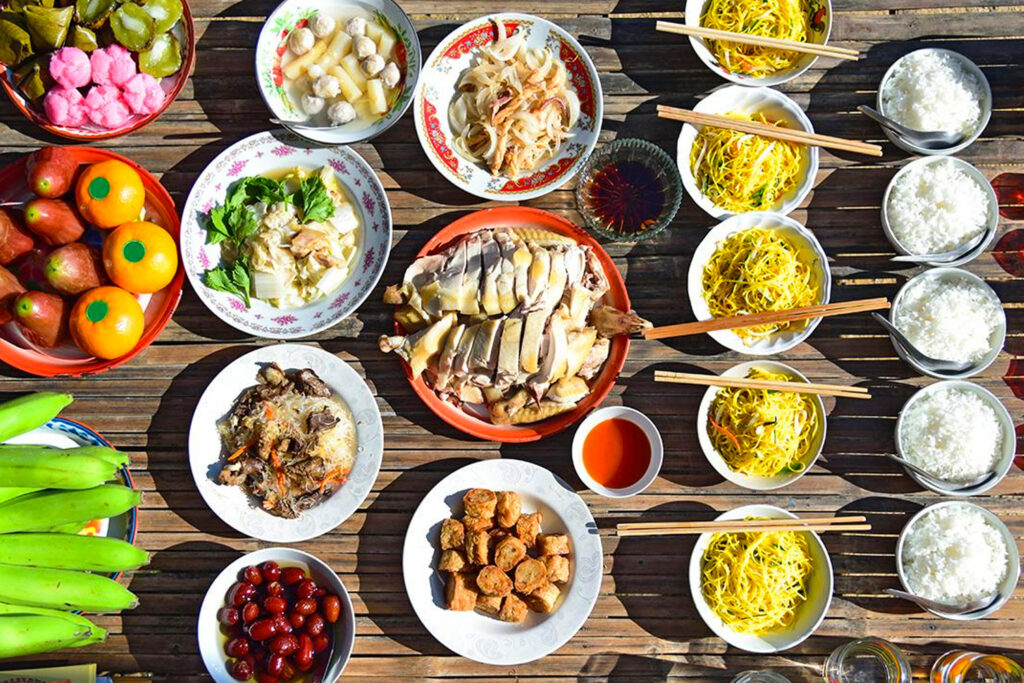
The ceremony is performed early in the morning outside the house. The offering table includes both savory and sweet foods, as well as two traditional festival cakes that are essential for the occasion: Khanom Thian and Khanom Keng (Nian Gao). A red dot is placed in the center of each cake, as red is regarded as an auspicious color in Chinese culture. Other offerings include fruits, tea, Chinese rice wine, and joss paper with paper money.
2. Offerings for the Ancestors
The offerings for ancestors are generally similar to those prepared for the household guardian spirits, with the addition of foods that the ancestors particularly enjoyed during their lifetime. According to tradition, a bowl of clear soup or a light dessert in syrup should be placed beside each bowl of steamed rice. Tea should also be prepared according to the number of ancestors being worshipped. Traditional festival cakes, including Thian Cake and Nian Gao (Khanom Keng), together with fruits and joss paper, are indispensable offerings. One important custom is that any food specially prepared for the ancestors must not be tasted before the worship ceremony.
3. Offerings for Wandering Spirits
Wandering spirits, or spirits without living relatives to worship them, are known in Thai as Samphawesi and are respectfully referred to in the Chinese tradition as Ho Hia Tee, meaning “our good brothers.” This reflects the Chinese custom of showing courtesy and respect by referring to spirits without relatives as “good brothers.” These offerings are placed outside the house. The offering table may include savory and sweet foods, fruits, traditional fragrant rice known as Kor Peng, steamed taro cut into wedges, a large bundle of Chinese vermicelli, Chinese rice wine, tea, and joss paper with paper money, all arranged together as offerings for the wandering spirits.
If you would like to read more articles, please visit the ARM’S ARMOR website. To make sure you never miss our latest articles, don’t forget to like, follow, and stay connected through the ARM’S ARMOR Facebook page. We have many more interesting articles waiting for you.